
Flexible Work Arrangements
Texas A&M University-Kingsville supports the use of flexible work arrangements in certain circumstances where it is consistent with the efficient operation of university campuses and the effective delivery of services to students, campus clientele, and the public. Flexible work arrangements include partially remote or fully remote alternate work location (AWL) agreements and flexible work schedules. While any university employee may request an AWL arrangement, not all positions may be suited for partially or fully remote work.
Alternate Work Location (AWL) Requests
Requests for Alternate Work Location (AWL) arrangements must be submitted in Workday for routing and approval. To submit an AWL request, use the Flexible Work Arrangement business process in Workday.
- Fully Remote Alternate Work Locations - A designation of an Alternate Work Locations which allows for employees to fulfill all their job duties from an Alternate Work Location. This arrangement does not require the employee to report to the primary duty station and allows them to fully function in their role, leveraging technology to work and communicate.
- Partially Remote Alternate Work Locations - A designation of an Alternate Work Locations which allows an employee to fulfill their on-site responsibilities at the assigned primary duty station while also providing flexibility to perform assigned functions from a designated work location. In this Alternate Work Locations arrangement, employees may be in an Alternate Work Location some, most, or all of the work week.
- Primary Duty Station - The place of employment associated with a traditional university campus facility or university-owned property. Primary duty stations include Texas A&M University-Kingsville Main Campus, Citrus Center in Weslaco, TX, and the RELLIS Campus in Bryan, TX.
- Designated Work Location - A fully remote work assignment where work duties are regularly performed as specified by the employer and suitable to an AWL arrangement because of the nature of the functions and business need associated with the location of the position.
AWL Guidelines
Employees in good standing and whose job duties and responsibilities are suitable for an alternate work location (AWL) arrangement may be allowed to perform assigned duties through a partially or fully remote AWL arrangement. Positions eligible for an alternate work location are those that are computer-based, not dependent on continual physical presence or face-to-face customer interactions, and largely self-directed.
Requests for an alternate work location effective at the start of the fiscal year (September 1) must be submitted by August 1 to allow adequate time for review.
Employees must initiate a request for an AWL arrangement according to System regulations and applicable university guidelines. AWL arrangement provisions are contingent on approval and should not be considered an employee entitlement.
Now that the alternate work location (AWL) process has launched in Workday, previously approved AWL arrangements must be submitted through the revised process for new consideration.
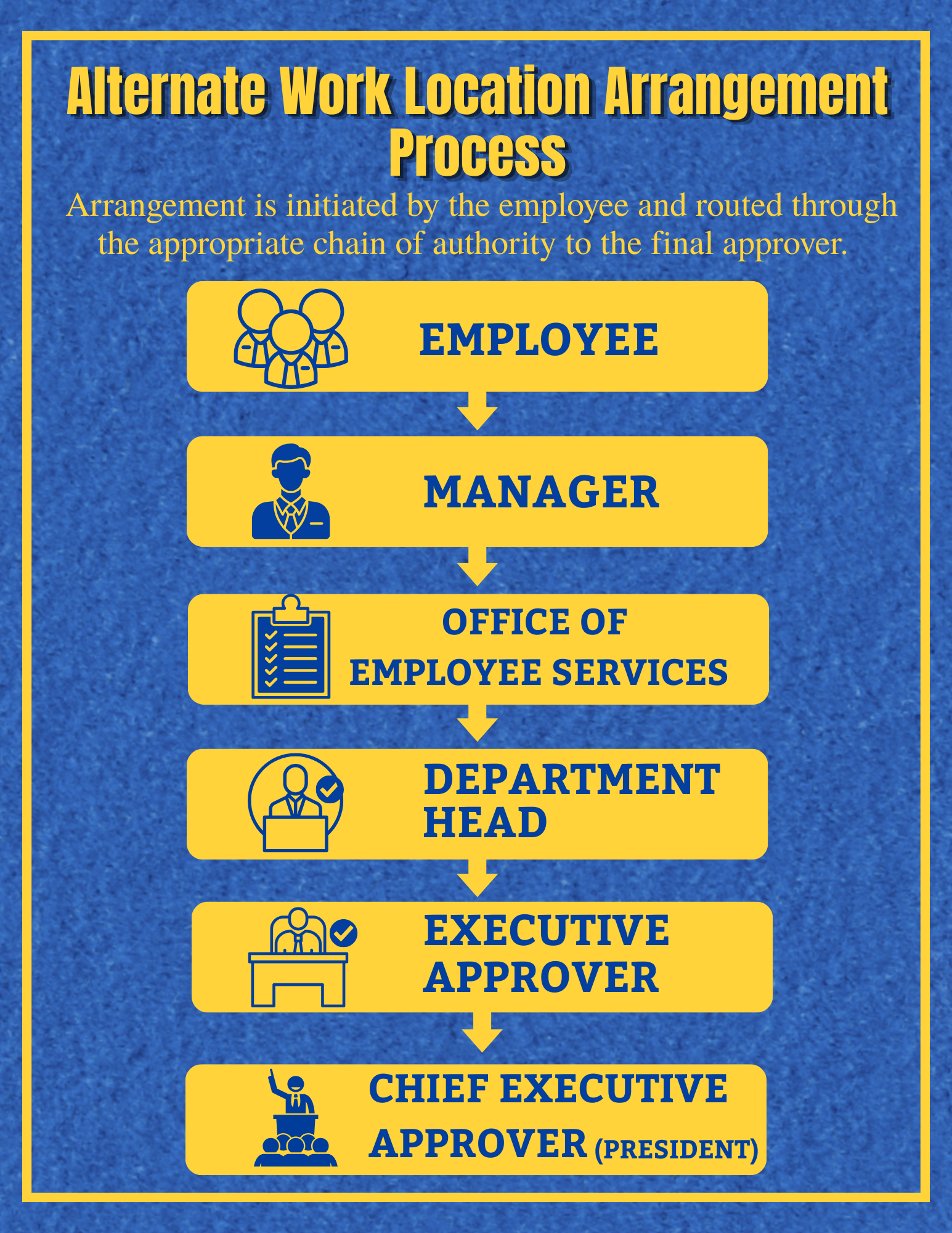
The AWL arrangement is initiated by the employee and routed through the appropriate chain of authority to the final approver (Employee > Manager > Human Resources > Department Head > Executive Approver > Chief Executive Approver). The Chief Executive Approver is assigned to the member chief executive officer (President).
Job Aid: Request Flexible Work Arrangement
Roles and Responsibilities of employees in the AWL Arrangement:
- Employees should have a discussion with their manager about the perspective of proposed advantages for an AWL arrangement and how their role is conducive to an AWL.
- Employees and managers should validate the applicability of relevant duties and responsibilities that may impact the continuity of services provided as well as any impact to supervisory responsibilities.
- Ensure the physical location of the AWL is accurately and appropriately disclosed and update the AWL agreement if circumstances and/or physical location change.
- Renew the AWL agreement each fiscal year.
- The use of equipment provided by the University is limited to authorized persons and for purposes relating to University business. No personally owned computers should be used and any computer or information-technology equipment used in the performance of University business must be used in compliance with all applicable University policies, including with respect to computer and network security and data security.
- Employees are responsible to maintain access to networking and/or internet capabilities at the AWL with sufficient bandwidth as necessary to perform the position's duties.
- Notify manager as soon as practicable whenever problems arise that may adversely affect ability to perform work at the AWL (e.g., power outages, technology issues, sick family members who require substantial attention, or other personal matters impacting their ability to perform their duties).
- Comply with the appropriate protocol for reporting computer security incidents or when the employee suspects there may have been an incident.
- During the hours the employee is on duty at an AWL, the employee must maintain a professional appearance and environment, be accessible by telephone, email, instant messaging system, or other appropriate communication technology or software, as determined by management.
- Ensure all university-owned equipment is used in compliance with applicable guidelines. Departments may create a plan to provide the employee with the necessary computer equipment required to conduct assigned duties, provided departmental funding is available. A department should deny an AWL in the event that university-owned equipment is not readily available or there is a lack of funding to furnish equipment. Additionally, the employee shall ensure they use the appropriate assigned account to access all university systems while working away from the primary duty station.
AWL Expectations
AWL arrangements are not intended to allow for work at other jobs, running businesses, or to engage in other activities that would otherwise result in the employee being required to take leave. The expectation is that normal work requirements, both qualitative and quantitative, must be met. Failure to comply with these restrictions or failure to fulfill normal work requirements on account of non-position-related activities may be cause for disciplinary action, up to and including termination of employment.
An employee in a non-exempt position may not work overtime (more than 40 hours in a workweek) without prior authorization from the employee’s manager.
Work Visas
If an employee is working at the University under a work visa, any conditions related to the work location must be satisfied. It is the employee’s responsibility to check with Texas A&M Immigration Services for Faculty & Scholars regarding their work visa expiration and any updates about their visa.
- What is an Alternate Work Location (AWL) Arrangement?
An AWL is a location apart from the traditional primary duty station (ie. office, laboratory, etc.) affiliated with the geographic location/facility associated with any Texas A&M University property. Employees must have an approved AWL arrangement before they can perform their job duties at the approved AWL. - Which staff positions are eligible for an AWL Arrangement?
Staff position eligibility for an AWL arrangement is determined by the essential functions of the position and how many hours of work must be accomplished at the primary duty station to meet the business needs of the department/division. These positions are typically, computer-based, not dependent on continual physical presence or face-to-face customer interactions, and largely self-directed.
The following types of positions are ineligible for partially or fully remote AWL: positions that are not computer based; positions that are dependent on continual physical presence; positions that require face-to-face customer interactions; and/or positions that are not largely self-directed. - Are faculty positions eligible for an AWL Arrangement?
Questions regarding faculty requests for AWL arrangements should be directed to provost@tamuk.edu. - Are student employees (including graduate assistants) or temporary/casual employees eligible for an AWL arrangement?
Requests for an AWL arrangement for student employees or temporary/casual employees may be considered only if a true business need exists and is properly documented by the manager. The manager must initiate the request in Workday on behalf of the student employee or temporary casual employee. -
Can employees use personal cell phones and computer devices to perform university business?
All remote work associated with the AWL program, should be done utilizing university or agency owned computer equipment. However, if an employee is working from home after hours, on their own personal time (such as evenings or weekends), they may use their personal cell phones and computer devices.Personal cell phones and other devices may be used for validating credentials with TAMU multi-factor security systems and authorized web-based systems, such as Email. Personal devices may be subject to TAMU policies and procedures if used to remotely operate authorized University assets and web systems. Security protocols within the AWL program are not intended to replace any statutory requirements in our Research programs.
In all situations, employees are expected to maintain security protocols appropriate for the specific law, contract, or legal framework governing data access and use. - How many hours/days can an employee work remotely each pay period?
The number of days/hours that an employee may perform work at an AWL is determined by the assigned duties of the position and the manager’s assessment of several key elements involving the organizational/business needs and availability of employees. Managers will determine the work schedule that is suitable for ensuring business continuity and employee productivity. - What hours am I expected to work when at an AWL?
Work schedule and hours should be discussed with and approved by a manager. Unless a flexible work schedule has been approved, employees are expected to work their regularly schedule hours which is typically defined as 8am to 5pm Monday through Friday. Any alternative schedules should be approved as a “Flexible Work Schedule”. - Who has the discretion to determine AWL arrangement eligibility and approve AWL requests?
An employee’s request for an AWL arrangement may be approved as submitted, modified, or disapproved by their manager.
First-line managers are responsible for determining eligibility given their familiarity and awareness of the relative portability of each employee’s duties and responsibilities and the regularity by which the employee must perform work at the primary duty station. This eligibility determination will be the first step in the approval process.
The following types of positions are ineligible for partially or fully remote AWL: positions that are not computer based; positions that are dependent on continual physical presence; positions that require face-to-face customer interactions; and/or positions that are not largely self-directed. - Is there a limit on the number of employees who are working remotely within an office/division?
There is no official cap on the number of employees who are eligible within an office, department or division. Position eligibility for an AWL arrangement is determined by the nature of work and how many hours of work must be accomplished at the primary duty station.
However, during the implementation of the AWL plans, Department/Division Heads should seek concurrence of AWL arrangements consistent with dean or vice president guidance to help ensure similarly situated employees are being handled equitably and uniformly. - Can an AWL arrangement be terminated?
Yes, an AWL arrangement may be terminated by the manager or the employee at any time. Reasons for termination may include circumstances where the arrangement is no longer conducive to the business needs of the organization, the employee’s performance diminishes, or the employee no longer wants to work from the approved AWL. Managers should give employees not less than two weeks’ notice of the termination of the agreement. - Does an existing AWL arrangement transfer with an employee if they take a new position?
No. Approval of an AWL arrangement is based on a supervisory determination of the nature of the work, and how many essential functions of the position require onsite presence. Transferring to a new position would require a new AWL agreement with the new manager. - Can an employee work remotely with a dependent in the household?
An AWL arrangement is not a substitute for dependent care. Employees may not work remotely with the intent of or for the sole purpose of meeting their dependent care responsibilities while performing official duties. While performing official duties, employees are expected to arrange for dependent care just as they would if they were working at the primary duty station. - Can managers work remotely while their staff are onsite?
Eligibility for remote work is based on the essential functions of the position and how many hours of work must be accomplished at the primary duty station. Review and concurrence of an AWL arrangement for supervisory employees while their staff is onsite would rest with Department/Division Head and dean or vice president as the Chief Executive Approver.
Flexible Work Schedule (FWS) Requests
A flexible work schedule (FWS) is a variation from the standard work schedule that gives employees greater flexibility to fulfill their job duties while allowing Texas A&M University-Kingsville (TAMUK) to maintain a progressive and productive work environment for all employees. All budgeted employees are eligible to request a flex schedule arrangement. Managers may approve an employee’s request for a flex schedule arrangement provided it does not compromise their work performance, productivity, or the collaborative pursuit of our mission.
- Flexible Start/End Times: Employees may begin and end work within a defined timeframe.
- Compressed Workweeks: Options such as four 10-hour days or 9-hour days with one half day are permitted.
- Rotating Schedules: Departments may implement staggered shifts to maintain coverage.
FWS Guidelines
Texas A&M University-Kingsville has approved Flexible Work Schedules for the period June 1, 2026, to July 31, 2026. Departments may authorize the use of flexible work schedules subject to the following roles and responsibilities.
At the discretion of the respective Vice President, certain areas may have blackout days, peak operational periods, and tight summer project deadlines that limit participation in the flex schedule. Employees are responsible for confirming their department's participation prior to submitting their request.
Employees must initiate a request for a Flexible Work Schedule (FWS) according to System regulations and applicable university guidelines. FWS arrangement provisions are contingent on approval and should not be considered an employee entitlement.
The FWS process has launched in Workday; previously approved FWS arrangements must be submitted through the revised process for new consideration. The proposed flexible work schedule form must be attached to the Workday business process.
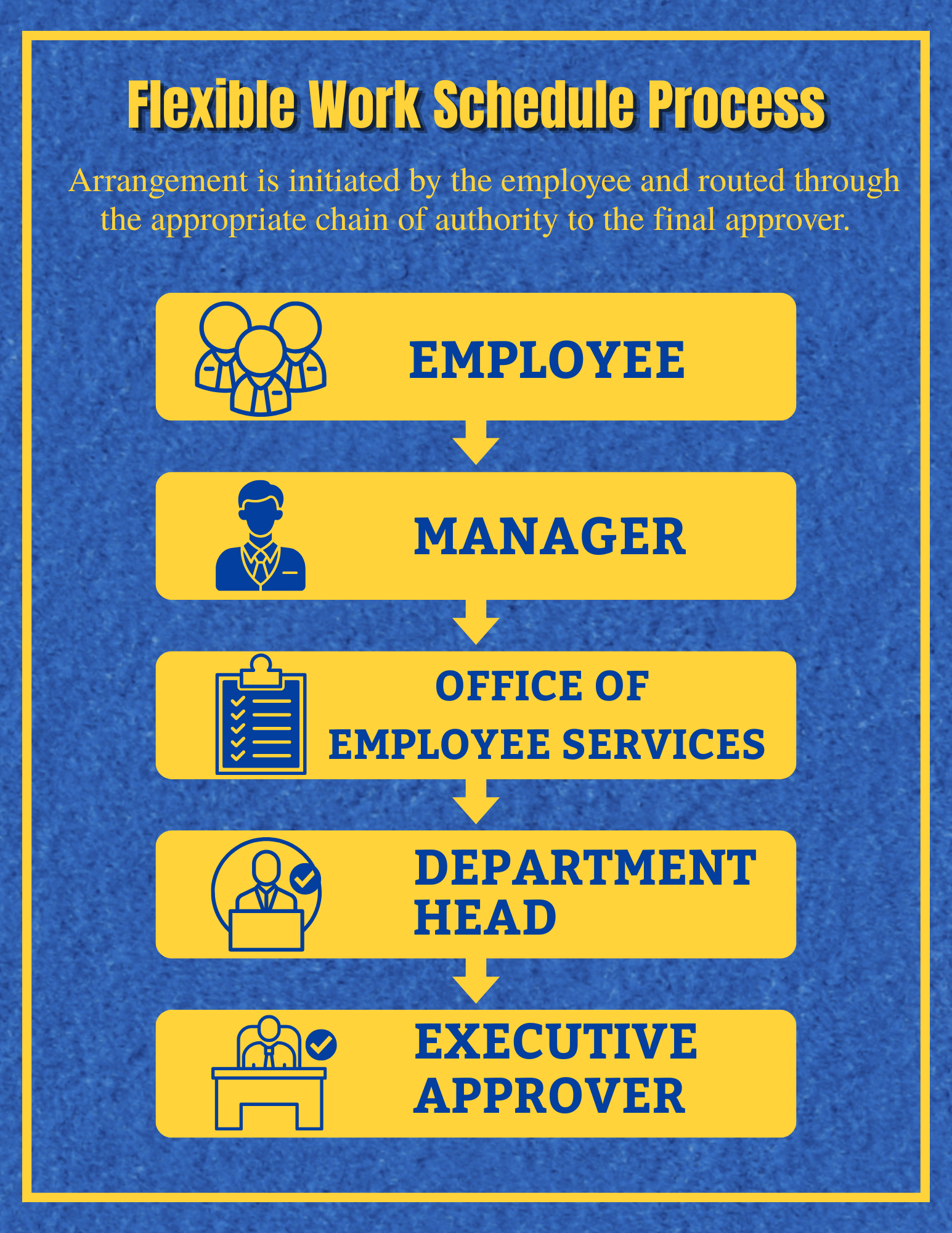
The FWS arrangement is initiated by the employee and routed through the appropriate chain of authority to the final approver (Employee > Manager > Human Resources > Department Head > Executive Approver). The Executive Approver is assigned to the respective Vice President or the most senior Division Administrator.
Job Aid: Request Flexible Work Arrangement
Budgeted employees in good standing and whose job duties and responsibilities are suitable for flexible work (flex) schedule arrangements are afforded the opportunity to establish a flex schedule, subject to the following conditions:
- The work week at TAMUK is Sunday through Saturday. The employee and manager set the employee’s desired flex schedule based on ensuring adequate coverage during the department’s normal hours of operation. The Department Head will ensure that the office is open for operation during the established business hours for their respective area.
- An approved flex schedule arrangement may be modified, continued, or discontinued at the discretion of management at any time. All flex work schedule arrangements must be routed for review and approval through the manager and appropriate administrative channels including the Department Head and Executive Approver in Workday before being
- Adequate staff coverage and supervision, sufficient to meet the operating requirements of the department and ensure quality service, are required at all times. Both internal and external customer needs must be considered to determine adequate staffing. One or more employees may assume, with the managers approval, coverage
- Work that requires regular supervision or essential interaction with other staff must be scheduled when managers and interacting staff are available.
- Employees who request a flexible work schedule must have at least a 30-minute break within the day.
Employees will:
- Plan and organize their time to meet the requirements established by the manager,
- Participate in the resolution of conflicts between the job and the flexible work schedule and inform the manager when coverage is not available.
Managers will:
- Ensure flexible work schedules are administered consistently and equitably;
- Ensure that the regulations/rules and coverage requirements are understood and adhered to;
- Following approval of the flex schedule, all original correspondence and related documentation will be maintained in Workday
Administration:
The computation of benefits is the same for employees with a flexible work schedule as for those working a standard schedule. Departments must ensure each non-exempt (paid hourly and eligible for over-time) employee in a flexible work schedule arrangement records total hours worked each day and documents exceptions to the normal work day (such as approved overtime, vacation, or other absences) in Workday. A flexible work schedule does not limit the hours that an exempt employee must work to complete job requirements.
Flexible Work Schedules at Texas A&M University-Kingsville will not be permitted during the weeks of scheduled holidays. All employees with an approved Flexible Work Schedule must maintain a 40-hour work week during the week of a scheduled holiday.
Leave requests must be submitted for hours missed during the employee’s flexible work schedule in Workday through the Workday Time worklet. For example, an employee whose flexible work schedule includes a 10-hour workday must submit a request for 10 hours of leave if that workday is missed due to illness or vacation.
Flexible Work Arrangement Resources
- System Policy 33.06: Hours of Work for Full-time Salaried Employees
- System Regulation 33.06.01: Flexible Work Arrangements
- Flexible Work-Schedule Form
- Workday