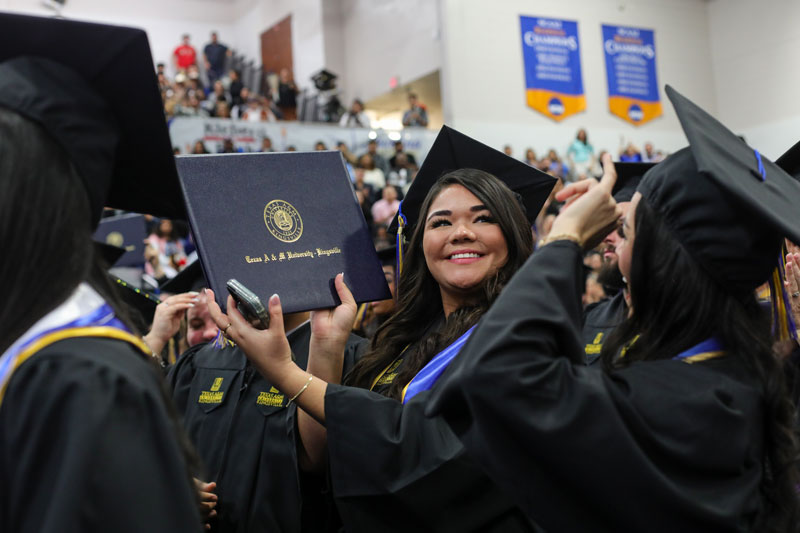
KINGSVILLE (Aug. 31, 2026) — When it comes to serving rural communities, Texas A&M University-Kingsville (TAMUK) is ranked among the best in the nation. The University ranked 5th in the United States in Washington Monthly’s 2026 College Guide’s inaugural Best Colleges for Rural America Top 100 list.
The rankings validate A&M-Kingsville’s steadfast commitment to serving rural South Texas through initiatives such as expanding access to quality healthcare through the creation of the College of Nursing and Health Professions and strengthening workforce development programs to meet the region’s growing needs across various trade industries.
“This ranking affirms the long-standing commitment to serving rural South Texas that has defined Texas A&M-Kingsville for a century,” Texas A&M University-Kingsville Dr. Robert Vela said. “Rural communities are home to incredibly talented students who reflect the values that shape South Texas—resilience, grit and perseverance. Our mission is intrinsically tied to supporting rural communities, and we are deeply honored to provide continued opportunities to the students and families in our backyard. Our work is measured not only in the success of our students, but also in the strength and advancement of rural South Texas.”
Nearly 35% of TAMUK students come from rural communities.
The Washington Monthly’s Methodology began with more than 1,000 rurally located schools identified by the Alliance for Research on Regional Colleges (AARC) Rural-Serving Post-Secondary Institutions project. The list was then filtered down to 225, excluding for-profit and two-year institutions, before finalizing the list based on social mobility metrics that included institutions’ Pell Grant percentage; the annual net price students from median-income and below families pay; median student loan debt; and the earnings of their alumni.
The rankings also include data from the U.S. Department of Education’s Integrated Postsecondary Education Data System (IPEDS) that identifies colleges graduating students in fields that are in demand in rural areas but in short supply.
Those fields defined by the National Center for Education Statistics Classification of Instruction include: Agriculture, Agriculture Operations, and Related Sciences; Natural Resources and Conservation; Parks, Recreation, and Leisure; Engineering; Health Professions and Related Clinical Sciences; Public Administration and Social Service Professions; and Education.
The identified fields closely align with the university's academic portfolio of undergraduate and graduate programs in engineering, animal and wildlife sciences, kinesiology, social work, veterinary technology, business, nursing, social work, education and more.
Within the rankings, TAMUK was ranked only behind the University of West Alabama, Sul Ross State, Georgia Southwestern State University, and Kentucky’s University of the Cumberlands. Within Texas, A&M-Kingsville Ranked No. 2.
Also notable within the rankings was TAMUK’s percentage of in-state students, which was ranked No. 2 only behind Georgia College and State University, which came in No. 72 on the overall list.
When ranking the percentage of students who receive a Pell Grant, TAMUK came in at No. 9 with 54 percent of students meeting the criteria. The list also predicted earnings for TAMUK graduates to be an average of $60, 271.
The university consistently ranks among the top schools in the state for social mobility, most recently coming in at No. 12 in Social Mobility among public universities in Texas (No. 15 overall) and No. 2 within the Texas A&M System in the U.S. News and World Report’s 2026 Best Colleges rankings.
-TAMUK-