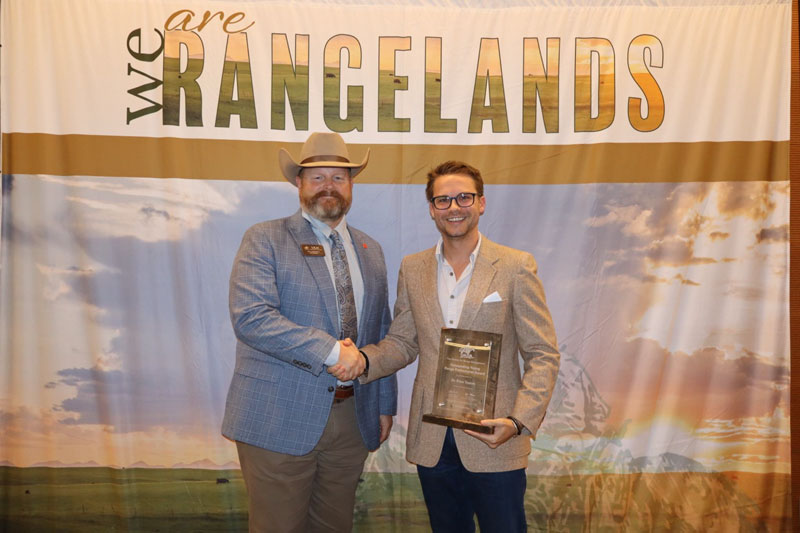
KINGSVILLE (April 1, 2026) — During the recent Society for Range Management’s (SRM) 79th annual meeting in Monterey, California, Dr. Evan P. Tanner, Assistant Professor and Meadows Professor of Semi-arid Land Ecology with Caesar Kleberg Wildlife Research Institute (CKWRI) at Texas A&M University Kingsville, received the Outstanding Young professional Award.
The award is presented to an individual member or couple who have demonstrated extraordinary potential and promise as range management professionals and serves as an encouragement for outstanding performance by young men and women entering the profession of range management.
‘I was excited to get the news, especially since I’ve really enjoyed my engagement with this professional society over the course of my career,” Tanner said. “I have focused a lot of my research here at A&M-Kingsville on solving problems in rangeland systems in Texas and beyond. With that in mind, being awarded was really special to me because not only is it coming from a society that I’ve put in a lot of time with and care a lot about, but I also heard from my colleagues who I’ve learned so much from. Just hearing their trust in my work and them believing that we’re doing impactful things down here in Kingsville is validating.”
Among Tanner’s projects highlighted by the SRM was a project funded by Texas Parks and Wildlife Department studying chestnut-bellied scaled quail, a game bird species that is on the decline in South Texas. The now six-year project uses the quail as an indicator species to help understand the declining ecosystem of the Tamaulipan Calcareous Thorn Scrub.
Tanner said it is a six-year project that has impact on a larger regional scale and has aided Texas parks and wildlife with its prioritization of conservation efforts of both game species and land management.
That research of the thorn scrub has now gone beyond this project and has been a benefit elsewhere.
“We want to promote the resiliency of Tamaulipan Thorn Scrubs in these rangeland systems,” Tanner said. “We’ve tied that into a bigger US Fish and Wildlife Service-funded project focused on restoration techniques for the Tamaulipan Thorn Scrub, focused in the Rio Grande Valley. We’re looking at how different restoration techniques promote targeted restoration goals once over the course of many decades once vegetation communities are lost. We’re collecting data to inform restoration targets and practices for the federal agencies implementing large scale restoration practices.”
Other highlights included large scale research of pronghorn within the North Texas and Oklahoma panhandle.
While being recognized for his efforts and earning validation from colleagues, Tanner was also proud that the award was specifically awarded to him in 2026, which has been named International Year of Rangelands and Pastoralist.
The United Nations General Assembly at its 76th session declared 2026 as the International Year of Rangelands and Pastoralists (IYRP2026), highlighting the critical role of rangelands and pastoralist communities in sustaining ecosystems, food security, and climate resilience.
The Food and Agriculture Organizations of the United Nations (FAO) is the lead agency for celebrating IYRP along with other relevant stakeholders as they look to raise awareness of the importance of rangelands and pastoralists, advocating for increased responsible investment and adapted policies for the pastoral sector.
“Rangelands are not only in the United States but are important to many different cultures on every continent except for Antarctica,” Tanner said. “To get this award during this designated year is really special, but I want to take the opportunity to highlight the importance of rangelands within our backyard. There are so many large ranching communities and opportunities held primarily by private landowners in South Texas. Almost 95 percent of those are rangeland systems, so what we’re focused on here at the CKWRI is collecting applied information to help guide the stewardship and management of those rangeland systems.”
-TAMUK-